

Overview
Employee Relations & Incident Management (HR-14) is where the organization records and tracks workplace incidents — accidents, injuries, safety violations, and property damage — alongside disciplinary actions, grievances, and investigations. Open the incident list from HR → Employee Relations → Incidents (route/hr/employee-relations/incidents).
The incident list
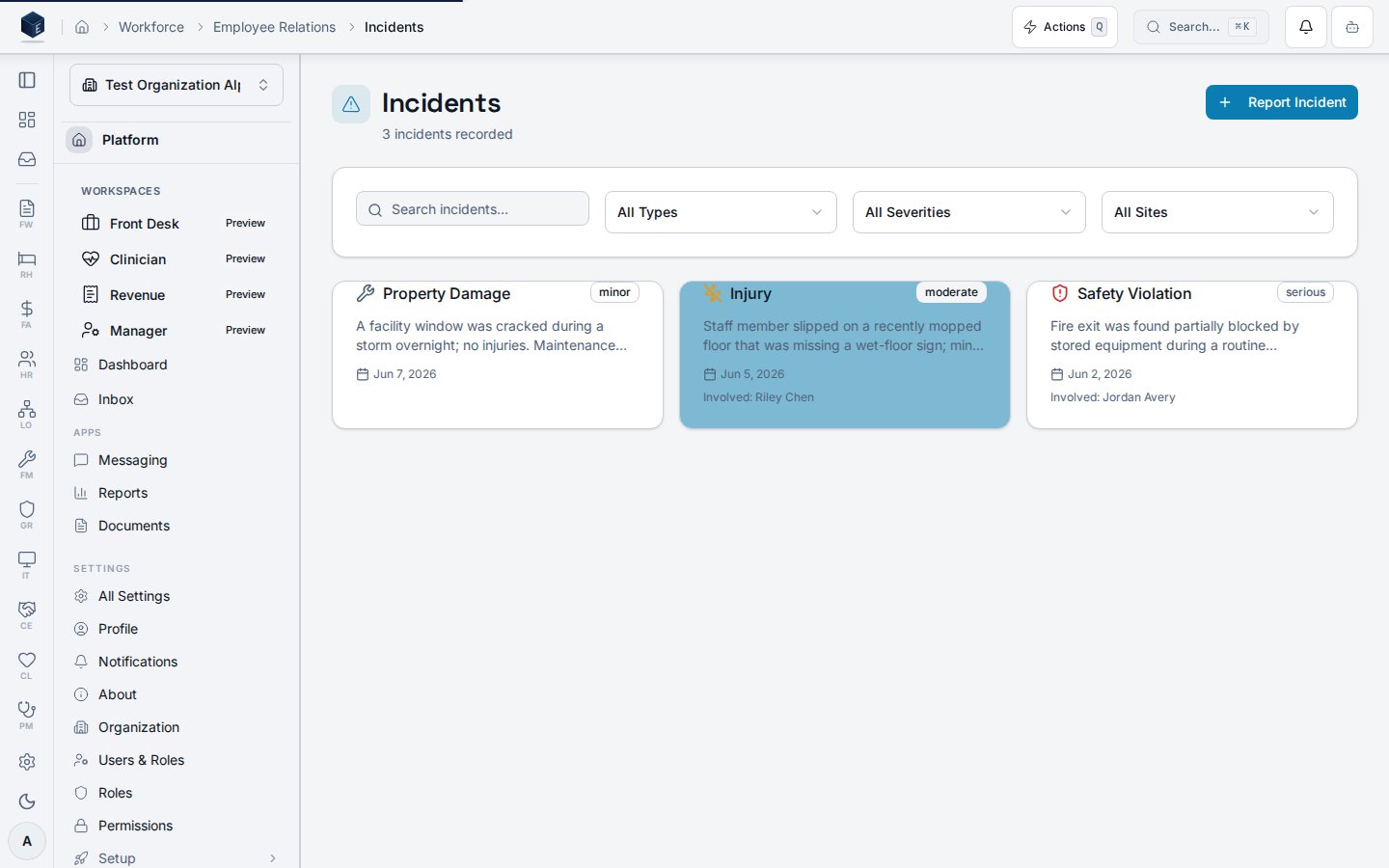
The incident list (/hr/employee-relations/incidents) shows every recorded incident
as a card with its type, severity, description, date, site, and the involved
employee (when one is named). A header count summarizes how many incidents are
recorded, and filters narrow the list by search term, type, severity, or site.
Incident types & severity
Incidents are categorized so safety trends are easy to spot:
Severity (minor → critical) drives the badge color and feeds escalation: serious and
critical incidents can trigger notifications and auto-assigned investigations.
Beyond incidents
The Employee Relations area also covers the cases that often follow an incident:- Disciplinary actions — warnings, suspensions, and terminations, optionally linked back to the originating incident.
- Grievances — employee-filed complaints (harassment, discrimination, wage disputes, working conditions), scoped so employees see only their own.
- Investigations — structured cases linked to an incident or grievance, with an assigned investigator, findings, and recommendations.
Why a single hub
- One record of safety events — every incident in one filterable list, so HR can see patterns by type, severity, or site.
- Context that carries — an incident can spawn a linked investigation or disciplinary action without re-keying the details.
- Accountability — each incident names its reporter and, where applicable, the involved employee.
Permissions
The screenshot above is generated automatically from the local end-to-end test
lane (
tests/e2e/hr/hr-14-incidents-docs-shots.spec.ts, run via
npm run docs:shots) against synthetic seed data. That spec also runs an auto-heal
gate — it fails on any console error, page error, or HTTP ≥ 400 while driving the
surface — and verifies HR-14 acceptance criterion AC-24 (an incident is visible
in the list showing the involved employee, with accessible details), so the image
reflects a clean, real render and is checked by the screenshot drift gate.