

Overview
The Employee Directory (HR-01) is the single source of truth for your organization’s people. Open it from HR → Employees (route/hr/employees,
gated by the hr.employees.view permission).
The directory lists every employee as a card or row showing their name, job
title, department, and employment status. It is the foundation the rest of HR
builds on — credentialing, onboarding/offboarding, scheduling, time tracking, and
payroll all reference the employee records maintained here.
Browsing and searching
The directory defaults to active employees and gives you several ways to find people:- Search by name, job title, work email, or employee number — results update as you type.
- Filter by employment status, department, and level.
- Switch views between a card grid and a compact list.
- Add a new employee, launch the Onboarding Wizard, or import / export the roster as CSV.
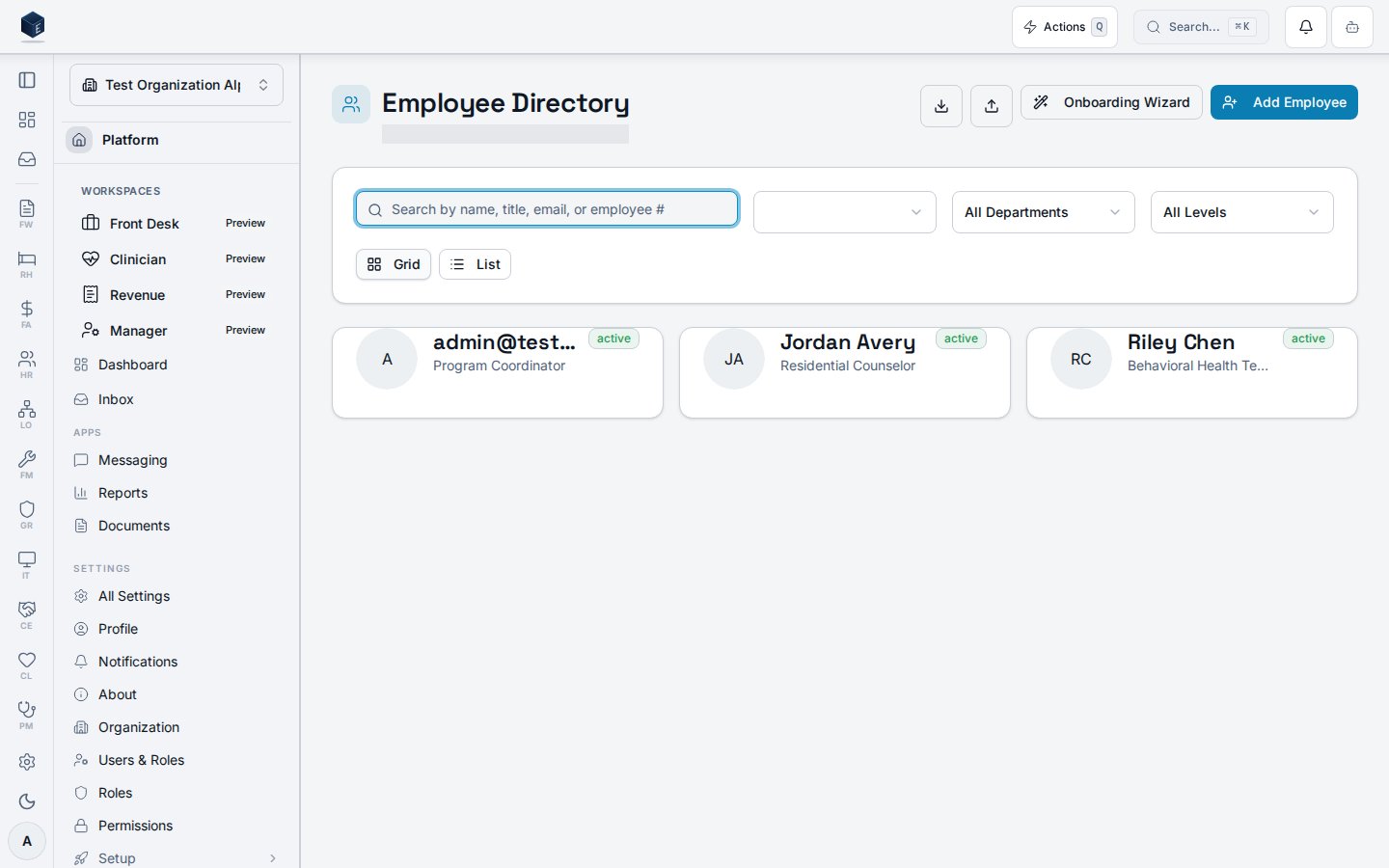
Active-only by default
The directory’s status filter defaults to active, so searching the roster surfaces only current employees. Terminated employees drop out of the default view and remain visible to HR administrators through the status filter, preserving employment history without cluttering everyday lookups.How the directory is used
- Departments & positions — employees are assigned to a department and a position from the org structure, keeping classifications consistent.
- Org chart — manager relationships between employees roll up into the reporting hierarchy.
- Downstream cores — credentialing, scheduling, time tracking, and payroll all read the employee record as their anchor for a person.
Permissions
The screenshot above is generated automatically from the local end-to-end test
lane (
tests/e2e/hr/hr-01-employee-directory-docs-shots.spec.ts, run via
npm run docs:shots) against synthetic seed data. That spec also runs an
auto-heal gate — it fails on any console error, page error, or HTTP ≥ 400 while
driving the surface — and verifies HR-01 acceptance criterion AC-5 (a search
of the directory returns matching active employees only), so the image reflects a
clean, real render and is checked by the screenshot drift gate.