

FA vs PM: FA owns general accounting. The healthcare revenue cycle — claims, eligibility, and ERA — lives in Practice Management.
How the books flow
Daily AP/AR and bank activity post to the general ledger, which drives period close, budgeting and forecasting, and tax reporting. Bank feeds arrive through Plaid for reconciliation.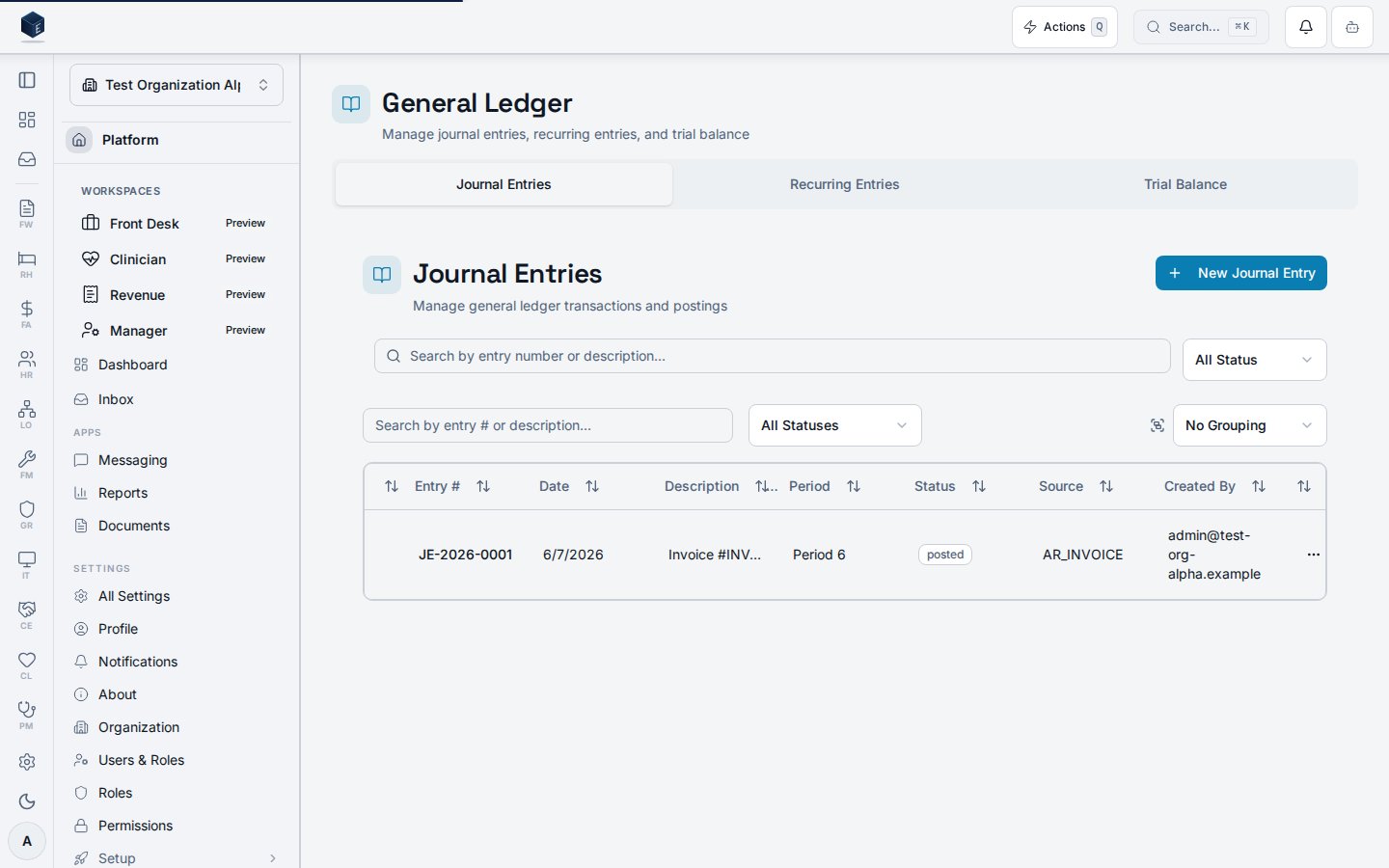
Key surfaces
1099 reporting
Vendor tax workflow — 1099-NEC and 1099-MISC.
1099 forms
Form generation and filing.
API reference
Developer integration surface for finance data.
Module settings
Tenant configuration for the FA core.
Plaid setup
Bank-connection integration for reconciliation.
Security considerations
PHI/PII guardrails for financial data.
Get oriented in FA
1
Configure the core
Set tenant options in module settings and connect banks via Plaid.
2
Run the books
Record AP/AR, journal entries, and reconciliations against the general ledger.
3
Report & close
Produce budgets, forecasts, and tax filings such as 1099 reporting.
By role
- Finance team
- Controller / CFO
- Auditor
Daily AP/AR, journal entries, and reconciliations. Connect banks in Plaid setup.
Scope at a glance
- General ledger & close — chart of accounts, journal entries, period close, intercompany.
- AP / AR — bills, vendor management, customer invoices, collections.
- Banking & cash — bank reconciliation, cash management, treasury, Plaid integration.
- Budgeting & forecasting — budgets, rolling forecasts, scenarios.
- Tax reporting — 1099-NEC, 1099-MISC, sales tax, jurisdiction reporting.
- Fixed assets & projects — capital tracking, depreciation, project accounting.
Related
VBP data pipeline
Value-based payment ties between clinical quality and finance.
Specs
Source specifications for the FA core.
Compliance tracking
Financial compliance crosswalk and evidence.