

Architecture: FW is a cross-cutting capability used by multiple cores through the Platform Integration Layer. Other cores consume FW via integration contracts and events — never direct imports.
How automation flows
Authors build forms and compose them into versioned workflow definitions. Triggers — cross-core events, scheduled cron, or webhooks — start a durable, resumable execution whose step history and completion feed analytics.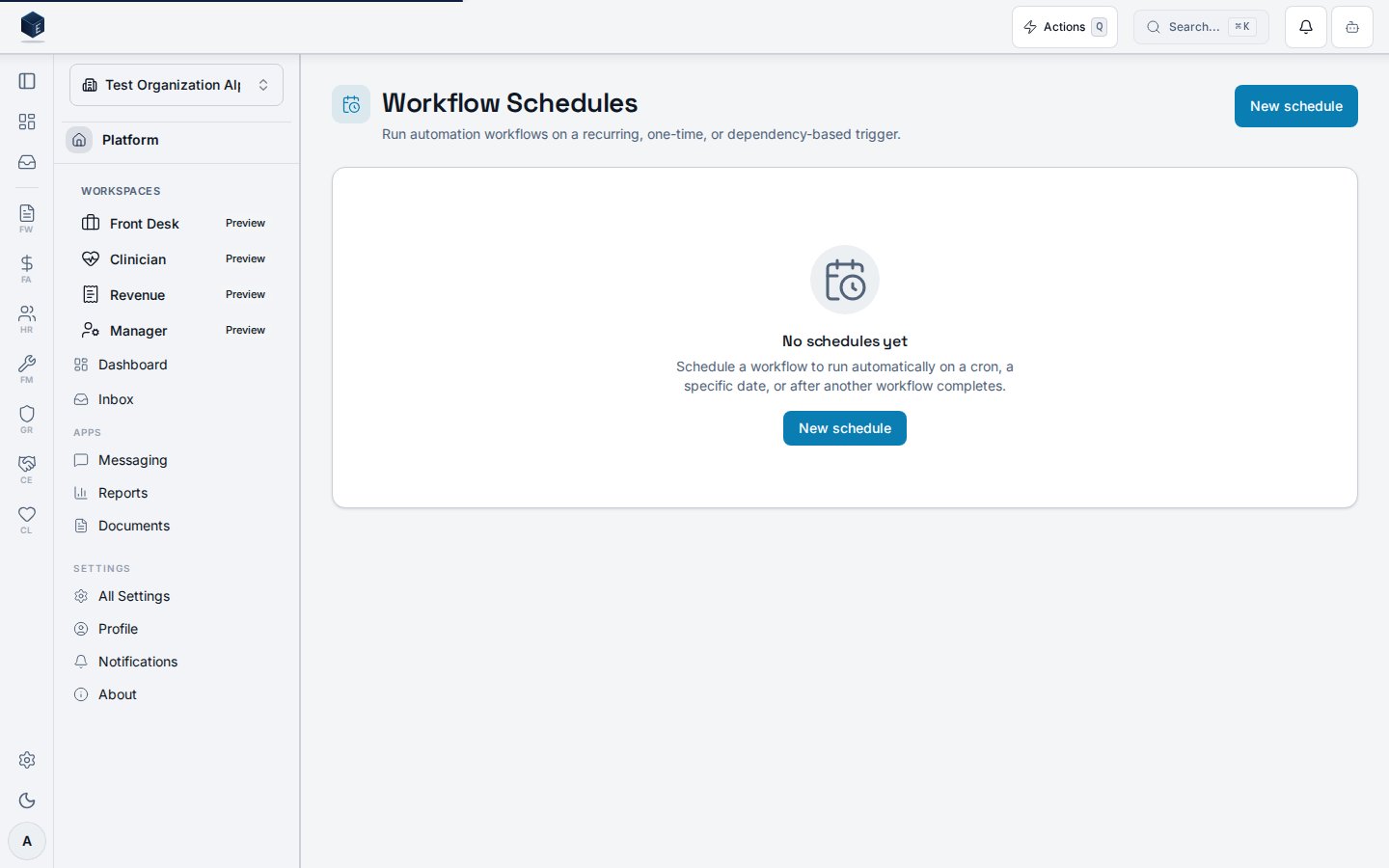
What FW covers
Form builder
Schema definitions, conditional logic, validation, and multi-step forms.
Workflow builder
Durable processes with branching, retries, and human-in-the-loop steps.
Durable execution
Long-running, resumable executions with full step history.
Event automation
Triggers from cross-core events, scheduled cron, and webhooks.
Versioning
Schema versioning and migration of in-flight instances.
Analytics
Completion rates, drop-off, and time-to-complete metrics.
Get oriented in FW
1
Build a form
Define a schema with conditional logic and validation in the form builder.
2
Define the workflow
Compose durable steps with branching, retries, and approvals.
3
Automate on events
Wire cross-core triggers so workflows run when other cores publish events.
By role
- Workflow administrator
- Operations engineer
- Compliance
Design and deploy workflows; manage versions and migrations.
Scope at a glance
- Form builders — schema definitions, conditional logic, validation rules, multi-step forms.
- Workflow definitions — durable processes, branching, retries, human-in-the-loop steps.
- Event-driven automation — triggers from cross-core events, scheduled cron, webhook entry.
- Versioning — form and workflow schema versioning, migration of in-flight instances.
- Analytics — completion rates, drop-off, time-to-complete metrics.
Related
Cross-core triggers
How FW listens to events from other cores.
HR integration
Workforce forms and workflow automation.
CL event automation
Clinical event hand-off into workflows.
PM business rules
Practice-management-triggered automation.